


Phất Dụ Núi – The resilient life force of Ha Long Bay’s Natural Wonder
Ha Long Bay is not only famous for its thousands of majestic limestone islands and mystical caves but also as a habitat for diverse plant species that contribute unique biological value to the heritage area. Among them, the Phất Dụ Núi (Dracaena cambodiana) stands out as a particularly common species, symbolizing the tenacious vitality of Ha Long’s nature.
Although not classified as an endemic plant of Ha Long Bay, Phất Dụ Núi is abundant, widespread, and characteristic of the bay. Rather than growing in isolation, this species often forms dense clusters, blanketing vertical cliffs, clinging firmly to mountain peaks, or lining the water’s edge. The green of the Phất Dụ Núi intermingled with the gray of the limestone creates harmonious patches of color, softening the grandeur of the natural landscape.
Phất Dụ belongs to the order Liliales, family Dracaenaceae. It is a small woody plant with a slender yet flexible form, growing anywhere from a few meters to over ten meters tall depending on the environment. This plant exhibits remarkable adaptability to the harsh terrain of the bay: scarce soil, frequent storms, and constant salty air erosion. As the stem ages and lignifies near the base, it branches out reaching heights of 2–4 meters, with reddish-brown bark on the older parts. The sword-shaped leaves cluster at the top, stretching upward. Its roots grow robustly, tightly gripping into rock crevices and penetrating deep into mountain walls to seek water and nutrients. Some ancient trees have roots deeply entrenched in rocky fissures.
Day by day, without any shelter or protection, the Phất Dụ Núi continues to stand tall under blazing sunlight and remains steadfast against strong winds and fierce storms.
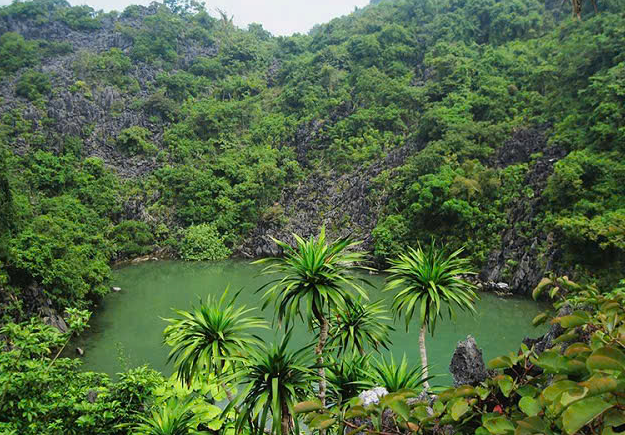
At the beginning of summer, Phất Dụ Núi enters its blooming season. Clusters of bright yellow flowers stand out vividly against the green leaves and the gray limestone background, adding beauty to the natural scenery of Ha Long Bay.
Locals call this plant by various common names, but the most popular remains Phất Dụ Núi—a name that evokes the image of a tall, straight form waving proudly in the sea breeze. The presence of Phất Dụ Núi not only helps balance the ecosystem of Ha Long Bay but also plays an important role in preventing erosion and protecting the limestone terrain from the effects of wind and seawater.
For the bay’s inhabitants, Phất Dụ Núi (commonly known as Giếng Guộc) has long been a familiar tree during the Lunar New Year season. Fishermen traditionally choose this plant to make the “Nêu” pole displayed on boats and floating houses of fishing villages that have existed for generations in Ha Long Bay. Moreover, for the local fishing communities who have lived here for thousands of years, Phất Dụ Núi is also a valuable medicinal plant. Its reddish-brown bark is used to improve blood circulation, reduce inflammation, and treat bone pain and bruises.
A special feature of Phất Dụ Núi is its widespread presence—from large islands to small rocky islets, the vibrant green of this plant can be seen everywhere. Despite harsh conditions, poor soil, scarce water, and enduring constant waves and wind, Phất Dụ Núi still stands tall and proud. The plant not only beautifies the landscape but also serves as a testament to the miraculous adaptability of life in the face of nature’s harshness. On Ha Long Bay, Phất Dụ Núi is more than just a plant species; it symbolizes the beautiful harmony between nature and humanity in this world wonder.
Translated by Thuy Ha