


Exploring the “Archaeological Museum” Inside Tien Ong Cave
Tien Ong cave is located on Cai Tai Islet, in the Hang Trai Island area, about 18 kilometers from Tuan Chau International Marina. The cave is also known by other names: Hang Rền (according to local folklore) and Hang Đục (as referred to by Swedish archaeologist Andersson).
Beyond its mysterious beauty with stunning stalactites and stalagmites, Tien Ong cave is especially remarkable as a site preserving valuable traces of ancient Vietnamese people.
According to archaeologists, Tien Ong Cave was one of the ancient residential sites of early Vietnamese people associated with the Soi Nhu culture in Ha Long Bay, dating back 10,000–8,000 years. The archaeological discoveries at this site have significantly contributed to uncovering the rich prehistoric history of the Ha Long Bay region.
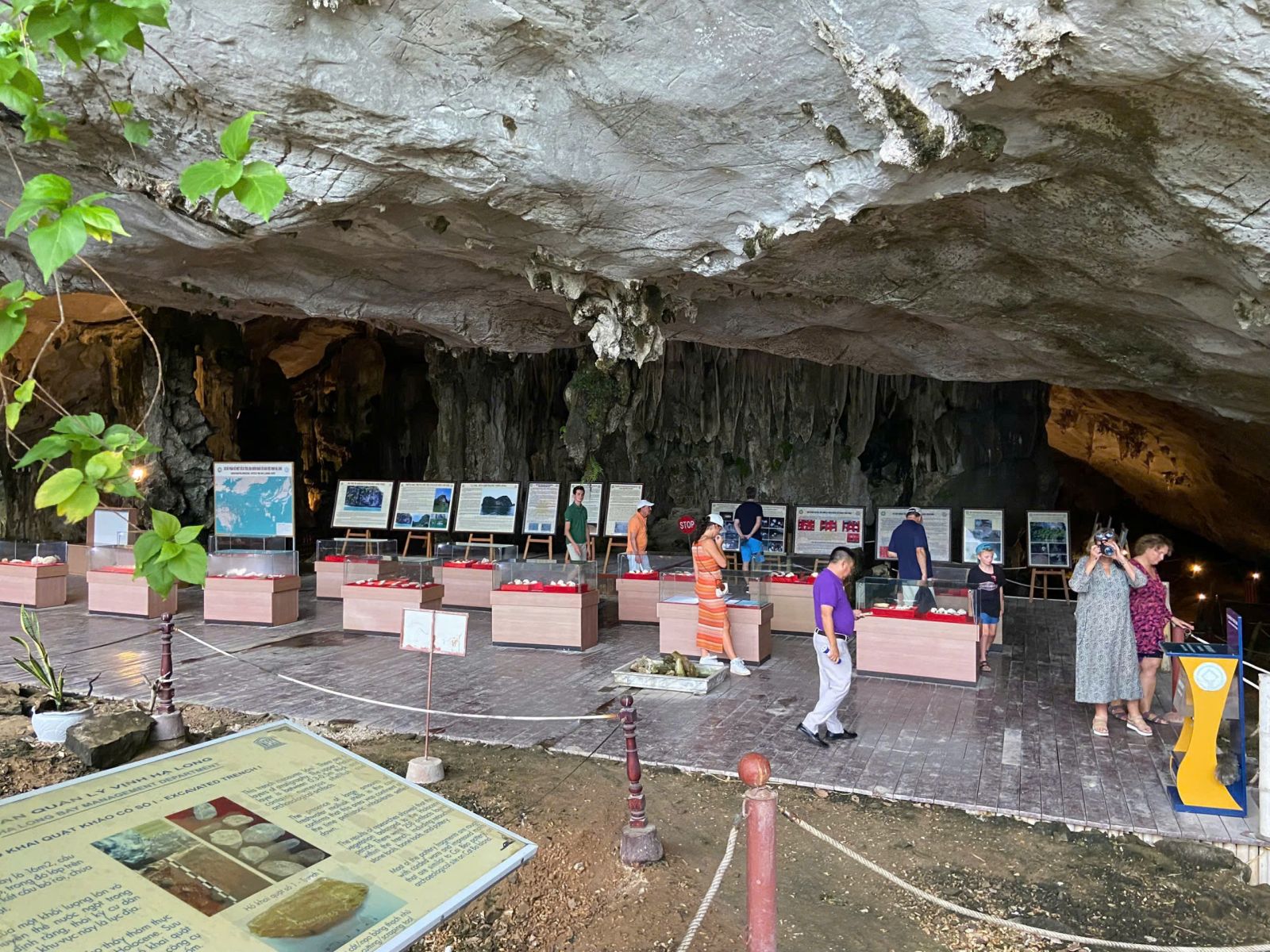
To preserve and present its archaeological value, in 2017, the Ha Long Bay Management Board, in collaboration with the Vietnam Institute of Archaeology and the Quang Ninh Museum, established an on-site archaeological exhibition inside Tien Ong Cave.
This exhibition serves as an “in-situ museum,” helping visitors gain a deeper understanding of the site's archaeological significance and the existence of an ancient culture that once thrived in Ha Long Bay-the Soi Nhu culture-dating from 18,000 to 7,000 years ago.
The Tien Ong cave archaeological exhibition is set up in the first chamber of the cave. It is presented in the form of panels and glass display cases, divided into two main sections:
Information & Interpretation Area:This section features bilingual panels (Vietnamese and English) that introduce the archaeological site of Soi Nhu Cave; key characteristics of the Soi Nhu culture; the location, naming, studies, surveys, and excavations of Tien Ong Cave; archaeological findings at Tien Ong Cave and Me Cung Cave
Artifact & document display: Displayed in glass cabinets and on pedestals with captions, this section includesoOfficial documents from relevant authorities regarding excavation permissions; research papers, excavation reports, publications, and seminar proceedings related to Tien Ong cave; actual artifacts from the site such as stone and bone tools (grinding slabs, pounding tools, cutting and scraping implements, pointed tools, flakes, hammerstones, cores, and axe preforms); animal remains and lithic materials; sediment blocks containing food remnants (stream snails, mountain snails, marine mollusks); scientific reports and assessments from the Vietnam Institute of Archaeology (2017), including analysis forms and sample identification sheets; photographs, detailed drawings, and technical illustrations of artifacts and excavation sites
Excavation pits display: Two out of four excavation pits (Pit No. 2 and Pit No. 3) have been preserved and exhibited for public viewing.
If you are passionate about history and culture-or simply curious to discover a deeper, lesser-known side of Ha Long Bay beyond its majestic scenery-Tien Ong Cave is the perfect destination.
Here, you can quite literally “touch” the past, experience the life of our ancestors from thousands of years ago, and better appreciate the priceless cultural heritage of Vietnam’s northeastern islands and seas.
Translated by Thuy Ha